Steer your AI before it builds.
Your brand and assets go in first. What comes back is checked against them, so it looks and sounds like you, whichever tool made it.
Works with Claude, ChatGPT, Gemini, and any agent that speaks MCP.

How it works
01Tools connect over MCP
02The agent drafts v1
03A link goes to reviewers
04Feedback anchors to elements
05The set returns as instructions
06One pass: every note actioned, v2 back for review
07Approved, on the document
08Shipped
Inside each stage
What happens at every step

Generate, steered.
Generate wherever you like: Claude, ChatGPT, Gemini, your stack. Your standards are already loaded via MCP, so the first draft starts closer. Nobody re-explains the brand to a chat tab.

Review, anchored.
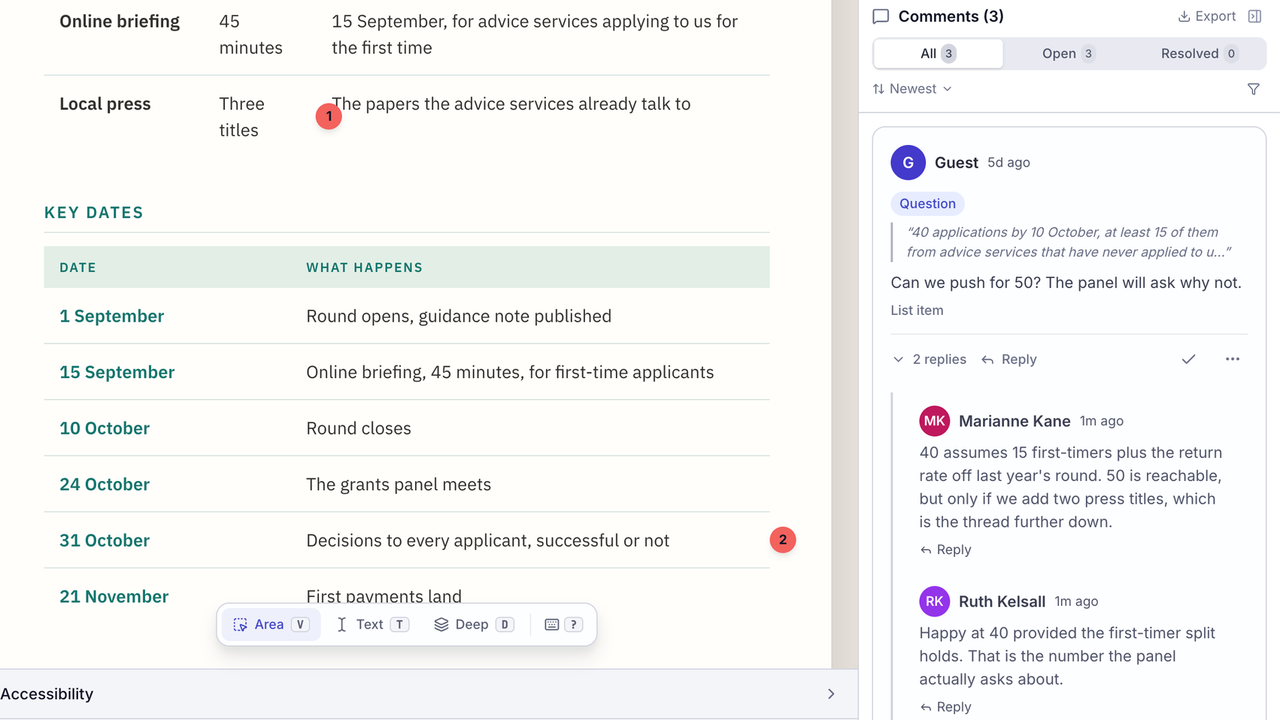
Comments anchor to the exact element, not a screenshot. Share a link with anyone; they type a name and start. No accounts, no seats.

Refine, in one pass.
Your agent reads the full set of annotations as structured instructions with priority and action hints, then addresses them in a single revision. No dribbled feedback, no regressions.

Ship, checked.
Branded deliverable URLs for the final version. Accessibility and brand checks catch what would have bounced it back.
See it in action
One review round, start to finish.
Click through a real session: an agent drafts the page, a reviewer marks it up in Sidenote, and every note gets addressed in the next version.
Why chat isn't enough
Great at asking. Bad at reviewing.
Detached feedback.
"The third paragraph feels off" makes your AI guess which paragraph and what off means. It guesses confidently, and wrong.
One note at a time.
Each chat fix regenerates the whole document. Pass four quietly breaks what pass two fixed.
Lost decisions.
Long chats compress. The tone call you settled forty turns ago falls out of context, and nobody notices until it ships.
Starting from zero.
Every new session re-learns your voice, your format, your rules. You are onboarding the same employee every morning.
The loop, closed.
Your AI agent handles the back-and-forth. You approve the final version. Sidenote speaks MCP, the open standard for connecting agents to tools, so it works with Claude, ChatGPT, Gemini, and anything else that speaks it.
Read the docsYour feedback becomes AI-ready
Every comment exports with its position, label, and full thread, in a structured format your AI agent can read and act on immediately.
Fix, upload, repeat
Your agent reads the feedback, makes the fixes, and uploads a new version. Previous comments automatically find their place on the updated document.
Know when it's ready to ship
Your agent can check how many comments are still open, whether the review is complete, and whether it's clear to publish. Build approval steps into your workflow without manual check-ins.
FAQ
Frequently asked questions
Those are generation tools. Claude Design only works in Anthropic. Canvas only works in OpenAI. Sidenote sits above every AI tool. You generate wherever you prefer, you review and refine in Sidenote, you ship from one place.
Chat feedback is detached from the document, so your AI has to guess what "the third paragraph feels off" actually points at. It arrives one note at a time, so each regeneration risks breaking an earlier fix. And it evaporates: long chats compress, settled decisions fall out of context, and every new session starts from zero. In Sidenote, feedback anchors to the exact element, travels as a complete set, gets applied in one revision with each item marked addressed, and your standards persist across sessions and tools.
Chat is where you ask. Sidenote is where you review. A draft comes out of your AI; the review layer is everything between that draft and shipped work: anchored feedback, iteration, brand and accessibility checks, delivery. Your AI tools do the generating, and Sidenote runs the loop that gets it to done.
Yes. Through MCP, your agent pulls structured annotations out of Sidenote, sees exactly what was flagged, and produces the next version addressing each point. No manual copy and paste of feedback into prompts.
Sidenote includes an MCP server (Model Context Protocol is the open standard for connecting AI agents to tools). Your AI agent connects securely, then can upload documents, read feedback, push new versions, and check review status, all without you in the middle.
That is the point. Sidenote is LLM-agnostic. One brand kit, one review workflow, every agent. Claude, ChatGPT, Gemini, custom. Nobody else sits above all of them.
No. You share a link, they type their name, and they're in. No sign-ups, no passwords, no seat fees for reviewers.
Any HTML file. That includes AI-generated reports, landing pages, email templates, documentation, and anything else your AI outputs as HTML. We also support PDF and image uploads. Your document's styles are fully isolated, so nothing bleeds into the review page.
They carry over automatically. We match each comment to its new position based on the surrounding content. Even if you've rewritten large sections, most comments find their way back to the right spot.
Yes. Documents are private by default. Only people with the share link can see them. We don't train on your content, we don't index it, and we don't share it. Your data is stored securely with access controls at the individual record level.
We check against WCAG 2.1 Level AA: colour contrast, missing alt text, heading order, landmark structure, and more. Each result has a severity level, and you can click any finding to jump straight to the element on the page.
Yes. Annotations export as JSON, structured so your AI agent can read them and act on them directly. PDF exports with visual markup, and Markdown, are on the way.